
ChainThink
Stay ahead, master crypto insights
The Threefold Struggle Behind Trump's Crypto Empire: Regulation, Ethics, and Financial Risk
The Threefold Struggle Behind Trump's Crypto Empire: Regulation, Ethics, and Financial Risk

2025-04-20 08:48
Original Title: Trump’s Newest Grift: Building a Cryptocurrency Empire While Destroying Its Regulators
Original Author: Molly White
Translated by: Daisy, ChainCatcher
In the context of Trump's return to power, the cryptocurrency industry is experiencing unprecedented regulatory relaxation. Seizing this opportunity, the Trump family has swiftly positioned itself across multiple sectors, constructing a crypto empire valued in the tens of billions, encompassing platform development, token issuance, infrastructure control, and market manipulation—where power and capital are deeply intertwined.
This process not only generates massive profits but also raises serious concerns about conflicts of interest and abuse of power. From platform ownership to policy intervention, from meme coin speculation to potential insider trading, the Trump family is transforming the national regulatory framework into a vehicle for personal gain.
This article will trace the operational pathways of the family’s crypto ventures, expose how they profit in a regulatory vacuum, and examine the systemic risks underlying this “expansion of a crypto empire.”
Capital Inflow, Regulatory Easing: How Crypto Capital Rapidly Opens Political Channels
Upon regaining power, Trump quickly received at least $20 million in political donations from crypto industry backers. Ripple and Andreessen Horowitz each contributed $5 million, while major players such as Coinbase, Gemini, Kraken, and Circle provided millions more in support.
These donors subsequently received policy rewards: at least eight enforcement cases brought by the U.S. Securities and Exchange Commission (SEC) against crypto firms were dropped or delayed. Many companies were also included in new rulemaking processes, enabling them to shape market regulations in environments lacking oversight, compliance requirements, and consumer protections—tailored specifically to their own interests.
The regulatory easing not only significantly benefited the donating firms but also cleared institutional barriers for the Trump family’s crypto expansion, laying the foundational conditions for their entire commercial operation.
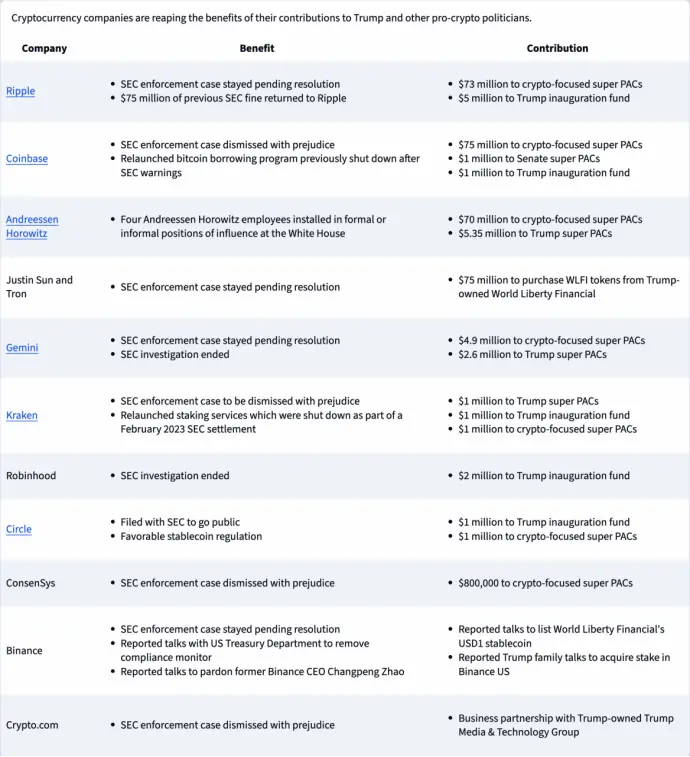
Source: Follow the Crypto
World Liberty Financial: The Core Asset of Trump’s Crypto Empire
In August 2024, Trump co-founded the crypto firm World Liberty Financial with partners. Zach Witkoff, one of the project’s co-founders, is the son of Steven Witkoff, a long-time ally of Trump and currently the Special Representative for Middle East Issues. Recently appointed as Trump’s private envoy on his visit to Putin, Steven Witkoff played a pivotal role in facilitating the project’s connections.
Despite the platform’s branding and positioning being almost entirely centered around Trump himself—its website even lists his son as a “DeFi Visionary” and “Web3 Ambassador”—and promises that 75% of protocol revenue will go to him, the family initially tried to maintain a veneer of distance. It wasn’t until Trump’s re-inauguration that he formally took control of 60%, becoming the actual controller.
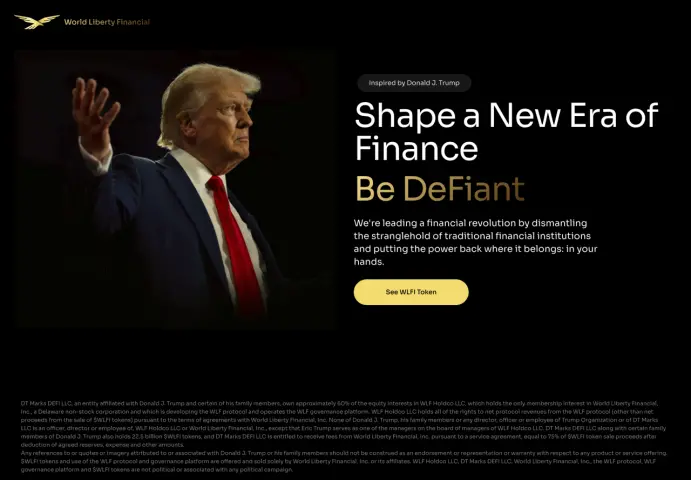
Source: World Liberty Financial homepage
Although no trading platform has yet launched, World Liberty has already raised $550 million. Based on revenue-sharing arrangements, Trump is projected to personally profit nearly $400 million. The company claims it will build a “financial democratization” platform and issue a stablecoin, USD1—an ironic departure from Trump’s past characterization of stablecoins as “government-controlled financial instruments.”
Notably, $75 million of the funding came from Changpeng Zhao—a foreign crypto entrepreneur under investigation by the SEC and Department of Justice for alleged fraud—who cannot legally donate directly to Trump. Subsequently, Zhao was appointed as an advisor to World Liberty, and after Trump’s inauguration, the SEC dropped its lawsuit against him.
The $WLFI token issued by World Liberty is defined as a “governance token,” theoretically granting holders voting rights. However, the platform team unilaterally advanced major initiatives—including the issuance of a stablecoin—without any formal vote. The token includes multiple regulatory evasion clauses: it is restricted to non-U.S. citizens or “qualified investors” and is currently non-tradable. Some investors speculate that once SEC regulation is further weakened, these restrictions may be lifted, allowing the token to enter secondary markets and generate returns.
Meanwhile, the project faces widespread allegations of insider trading. Media reports reveal that World Liberty acquired Movement Labs’ tokens for approximately $2 million just as rumors surfaced about the latter’s potential blockchain collaboration with Elon Musk’s newly formed “Department of Government Efficiency.” Although both parties denied the talks, the market reacted sharply.
On April 8, 2025, a memo released by Deputy Attorney General Todd Blanche confirmed that, under a presidential executive order, the Department of Justice had formally dissolved the cryptocurrency investigative unit and terminated all related enforcement actions. This move effectively severed federal investigation pathways targeting the Trump family’s crypto ventures.
The launch timeline of USD1 also drew attention: on March 25, World Liberty announced plans to issue the stablecoin. Just ten days later, the SEC stated that “certain types” of stablecoins fall outside its regulatory scope, allowing firms to issue without registration. Meanwhile, Congress is advancing legislation pushed by pro-Trump factions to ease regulatory constraints on stablecoins. Behind this lies over $130 million in lobbying spending by the crypto industry during the previous election cycle.
Additionally, World Liberty is negotiating with Binance to list USD1 on its platform. If successful, the project would gain access to the user base of the world’s largest crypto exchange, unlocking massive revenue potential. At the same time, Binance is engaged in ongoing talks with the U.S. Treasury over compliance matters, seeking to lift a prior regulatory agreement stemming from a settlement involving over $4 billion in fines for anti-money laundering violations.
Truth Social & Truth.Fi: Social Platform Shifts Toward Crypto Investment
Trump’s “Trump Media & Technology Group” (TMTG), the parent company of Truth Social, has recently begun venturing into the crypto space. The company is publicly traded, with a valuation of approximately $2 billion, and Trump holds about 53% stake. Recently, TMTG applied to allow a trust fund controlled by Donald J. Trump Jr. to sell its shares.
In January 2024, TMTG announced its entry into fintech under the brand “Truth.Fi,” launching so-called “America First” investment products. On March 24, the company announced a partnership with Singapore Exchange’s Crypto.com. Notably, the platform had previously been under investigation by the SEC and received a “Wells notice” in August, signaling impending enforcement action. Yet just three days later, Crypto.com announced that the SEC had terminated the investigation.
Meanwhile, TMTG stated it would deploy up to $250 million in cash reserves to invest in cryptocurrencies like Bitcoin. Through this move, the company—effectively Trump himself—stands to directly profit from his own public statements that influence market sentiment. Policies such as proposing a Bitcoin strategic reserve or pushing government funds to purchase Bitcoin could have tangible impacts on market dynamics.
Blockchain Gaming Initiative & Regulatory Easing: From Monopoly to Real-World Arbitrage
According to Fortune magazine, Trump is preparing to launch a blockchain-based real estate-themed game, resembling Monopoly but built on a cryptocurrency ecosystem, emphasizing “play-to-earn” mechanics to attract players who can earn real value through gameplay.
Such games have long drawn criticism due to imbalanced economic structures and ethical risks. Wealthy players can “pay to win,” while those with limited resources struggle to participate, and the system heavily relies on continuous inflows of new users to sustain token value—posing a high risk of collapse if growth slows.
Axie Infinity, which went viral in 2021, sparked the “digital serfdom” model: wealthy individuals leased game assets to low-income players in developing nations, promising income exceeding local wages. This practice led to widespread ethical controversies, including underage participation in gambling-like mechanisms and players losing real money with no return. In March 2022, the game suffered a cyberattack by North Korean hackers, resulting in losses of approximately $625 million, and its token price has never recovered.
In recent years, U.S. regulators have intensified scrutiny of such projects. The SEC sued Coinbase and Binance, alleging they listed unregistered securities, including Axie Infinity’s $AXS, The Sandbox’s $SAND, and Decentraland’s $MANA. Simultaneously, the Consumer Financial Protection Bureau (CFPB) has focused on exploitative practices in the monetization of in-game tokens, particularly concerning minors.
However, since Trump’s return to office, these regulatory barriers are rapidly being dismantled. He has pushed for relaxed restrictions on crypto firms, including eliminating registration, compliance, liability, and gambling mechanism oversight. The SEC has recently “accelerated” the dismissal of multiple enforcement actions against Binance, Coinbase, and related gaming tokens, declaring most crypto assets outside its jurisdiction and inviting industry executives to help draft new rules.
The Trump administration also advocates for the complete abolition of the CFPB, a proposal openly supported by top crypto executives. In Congress, both the House and Senate have passed legislation to repeal CFPB rules specifically targeting crypto games—rules originally designed to protect minors and non-gaming crypto investors.
This repeal bill reveals stark partisan division: Democrats and independent lawmakers unanimously oppose it, while every Republican lawmaker except one symbolic dissenter supports it. The bill now awaits Trump’s signature. Once signed, it will not only eliminate all regulatory barriers to such activities but also deliver direct benefits to Trump and his crypto ventures.
Trump Family Enters Bitcoin Mining: Renewed Concerns Over Patronage and Profit-Sharing
At the end of March 2025, Trump’s two sons—Eric Trump and Donald J. Trump Jr.—announced investments in American Bitcoin, a bitcoin mining company, with Eric joining as Chief Strategy Officer.
The company was established with assistance from mining firm Hut8, which transferred “almost all” of its mining equipment to the new entity, sparking industry skepticism. VanEck analyst Matthew Sigel commented: “I truly cannot understand why they would trade 61,000 mining rigs for just 80% of a subsidiary they previously fully owned.” Many observers believe this resembles a “political stock swap”—Hut8 ceding 20% equity to the Trump family in exchange for policy favors and potential returns.
Eric Trump stated the company plans to go public in the future and will collaborate with World Liberty Financial. He also revealed plans to retain some mined bitcoins, betting on Trump’s next push to drive Bitcoin prices higher, thereby capturing asset appreciation gains.
Massive Meme Coin Launches: Trump Family Cashes Out Billions
Just before Trump’s reinauguration, he launched a meme coin named $TRUMP, shocking even some crypto supporters. Industry insiders described the move as “blatant fundraising” and criticized it as “absurd, setting a new low for stupidity.”
Shortly thereafter, the family launched $MELANIA, further fueling controversy. Bloomberg estimates that by early March, the Trump team had cashed out at least $350 million from these two tokens. On April 15, a wallet controlled by Trump reportedly sold another $4.6 million worth of tokens.
Meanwhile, the $MELANIA team allegedly offloaded around $4.5 million in tokens between late March and early April. On April 7, chain analysis platform Bubblemaps disclosed that insiders transferred approximately $30 million in tokens from wallets labeled “community distribution” and sold them en masse. More concerning, the team has also been accused of manipulating and engaging in insider trading involving the $LIBRA token linked to Argentine President Javier Milei, as well as multiple Solana-based meme coins.
In the initial allocation of $TRUMP tokens, Trump and his associates hold a controlling 80% stake, with a three-year linear vesting schedule. The first unlock is imminent, allowing Trump to sell up to 40 million tokens, valued at approximately $310 million at current prices. Meanwhile, many early investors have suffered heavy losses, with the token price plummeting from a peak of $75 to under $5.
Although these transactions potentially involve market manipulation or insider trading, regulatory oversight remains absent. On February 27, the SEC explicitly stated that meme coins fall outside its regulatory scope. Normally, such potential criminal conduct should be investigated by the Department of Justice, but the agency has been instructed to prioritize “immigration and procurement fraud” investigations, leaving the crypto market unaddressed.
In short, the Trump family is leveraging the regulatory vacuum to achieve high returns with minimal risk in the meme coin market.
NFT Tactics Revisited: From Self-Purchasing “Obscure Art” to Selling “Criminal Cards”
Beyond cryptocurrencies and meme coins, the Trump family has actively entered the NFT (non-fungible token) market. In December 2021, Melania Trump launched her first NFT collection, but the market response was lukewarm. A piece with a starting bid of around $250,000 received no bids and was eventually allegedly purchased by her for approximately $170,000.
In July 2023, she launched a second series, again sparking controversy. The project used NASA imagery, allegedly violating NASA’s prohibitions on commercial use. The series also performed poorly, selling only 55 units in a week and generating less than $5,000 in revenue.
In contrast, Trump himself has demonstrated stronger commercial returns in NFT projects. In December 2022, he launched his first set of “digital trading cards” (Trump Cards), deliberately downplaying the “NFT” label. These cards portrayed an idealized image—muscular, youthful, dressed in superhero or cowboy attire—exaggerated and detached from reality.

One of Trump’s digital trading cards (from OpenSea)
Subsequent series went further, directly featuring Trump’s arrest mugshot and offering buyers “upgrade rewards,” including fragments of the suit he wore—and even the chance to dine with him during his New York criminal trial.
Unclear Holdings, Coordinated Speech: Public Concern Over Family’s Crypto Asset Positions
Although the Trump family’s crypto asset holdings remain opaque, public financial disclosures and blockchain records offer partial insights. In August 2024, Trump reported holding Ethereum (ETH) valued between $1 million and $5 million, aligning closely with the $2.28 million balance in his wallet at the time. Since December 2024, the wallet began large-scale ETH sales, and most of the holdings have now been liquidated.
Other family members’ holdings remain undisclosed, but clearly present opportunities to profit directly from market volatility influenced by policy shifts. Some even appear to actively “move the market.” For example, Eric Trump posted in February: “Now is a great time to increase your $ETH position—remember to thank me later.” Almost simultaneously, World Liberty Financial, controlled by the Trump family, made a large ETH transfer to Coinbase, raising suspicions of coordinated “pump-and-dump” behavior.
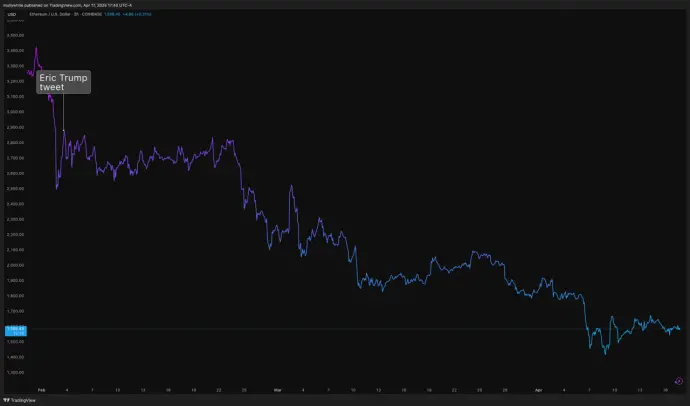
More troubling is the potential for insider trading within Trump’s inner circle. They are intimately familiar with his decision-making patterns and may possess non-public information. Trump’s sudden policy announcements often trigger sharp market swings.
A recent example illustrates this clearly: after Trump announced his “Liberation Day” tariff policy, causing a stock market crash, signs emerged that certain insiders bought at lower prices and exited after the policy suspension news, profiting from the rebound. Similar tactics are likely occurring in the crypto market. With volatile asset prices like Bitcoin, early access to policy direction enables substantial profits via information asymmetry.
The Ultimate Form of Power Monetization: From Regulatory Collapse to Systemic Risk
The conflicts of interest surrounding the Trump family’s crypto ventures far exceed the “honorarium clause” disputes of his first term. By launching multiple projects, Trump has established a comprehensive path to profit from power: direct gains from tokens and enterprises, shaping favorable regulatory policies for his investments, involvement in suspected insider trading, and creating channels for foreign actors to gain political influence through “investment”—which, if converted into campaign contributions, would constitute illegal acts.
Meanwhile, the regulatory framework is being systematically dismantled. Trump continues to weaken constraints on the crypto market, exposing ordinary investors to fraud and manipulation risks, while he and his backers face virtually no meaningful scrutiny.
Despite increasingly evident signs of abuse of power, current checks and balances remain ineffective. While some Democratic lawmakers have written to the SEC inspector general, DOJ leadership, and state attorneys general urging investigations into the Trump family’s conflicts of interest, no substantive progress has been publicly reported.
Even more alarming is the growing convergence between the president’s personal financial interests and national policy authority, as regulatory erosion transforms the crypto market into a playground for the elite: high-risk lending schemes cloaked in “financial democratization,” fraudulent activities disguised as innovation, and meme coins repurposed as tools for “pump and dump” schemes.
In this process, ordinary investors are marginalized and lack recourse. The risks of this deregulation experiment are spreading into traditional finance. As banks expand exposure, pension and retirement funds increasingly enter the space, society as a whole quietly bears the systemic costs—benefits accruing to a tiny few, while losses are borne by everyone else. When the bubble bursts, victims will include not only speculators but also countless ordinary people who never participated.
Disclaimer: Contains third-party opinions, does not constitute financial advice


AI Practical Guide
This column focuses on the real progress of Agents: technological evolution, application implementat

Crypto Weekly
Tracking on-chain movements of the smart money and institutions

Frontier Insights
Spotlight on Frontier, trending projects, and breaking events

Blowup Alert
As the 2026 crypto bear market deepens, exit scams and project blowups are becoming increasingly fre

Regulatory Watch
American Crypto Act – timely interpretations of policies worldwide

Popular Airdrop Tutorial
Selected potential airdrop opportunities to gain big with small investments

FusnChain
FusnChain