
ChainThink
Stay ahead, master crypto insights
The Boom Era of U.S. Crypto Enterprises: Mergers and Acquisitions, IPOs, and Tokenization Surge
The Boom Era of U.S. Crypto Enterprises: Mergers and Acquisitions, IPOs, and Tokenization Surge

2025-04-16 19:18
Author: Nianqing, ChainCatcher
Recently, the U.S. Securities and Exchange Commission (SEC) has taken a series of "zeroing out" dismissals against crypto companies, with lawsuits against Kraken, Consensys, Cumberland, Ripple, Robinhood, Nova Labs, and others being dismissed. SEC's new chair, Paul Atkins, has officially taken office and stated that establishing a regulatory framework for digital assets will be his "top priority," completely changing the previous closed and high-pressure regulatory style. At the same time, the U.S. Department of Justice has clearly stated that crypto developers are not responsible for the use of their code by criminals and do not need to bear liability.
It is clear that the clarity and easing of regulation are driving crypto companies into a period of rapid growth.
Currently, U.S. crypto companies are experiencing a wave of IPOs and mergers and acquisitions. Dozens of U.S. crypto companies are striving to seize the window of opportunity to push for listings. In addition, more projects are exiting through M&A, with over 10 M&A deals occurring continuously for five months since November 2024. Large-scale M&A transactions are frequent, and the transaction amounts keep breaking the historical highs of the crypto market. The crypto market is entering a phase of integration and institutionalization. One-stop, integrated platform-type crypto giants will continue to emerge.
What are the crypto giants positioning themselves for? What impact will this have on the future of the crypto market?
IPO Surge: Seizing the Window of Opportunity
2021 was a peak year for the crypto industry, benefiting from the surge in Bitcoin prices, low interest rate environment, and SPAC frenzy, multiple crypto companies planned to go public or use SPAC to raise funds and enhance market influence. On April 14, 2021, Coinbase successfully listed on Nasdaq, marking a milestone for the mainstreamization of the crypto industry. However, other crypto companies did not have the same luck as Coinbase. Circle, Kraken, Ripple, BlockFi, eToro all had plans for IPOs or SPACs in 2021, but some were shelved due to regulatory uncertainty and market volatility.
In the second half of 2024, Trump's election reopened the IPO window for U.S. crypto companies. Currently, several crypto companies have gone public in the United States. Japanese cryptocurrency exchange Coincheck completed a merger listing on December 11, 2024; Fold Holdings merged via SPAC and successfully listed on Nasdaq on February 19; Amber Group's digital wealth management platform Amber Premium has completed a merger listing in March.
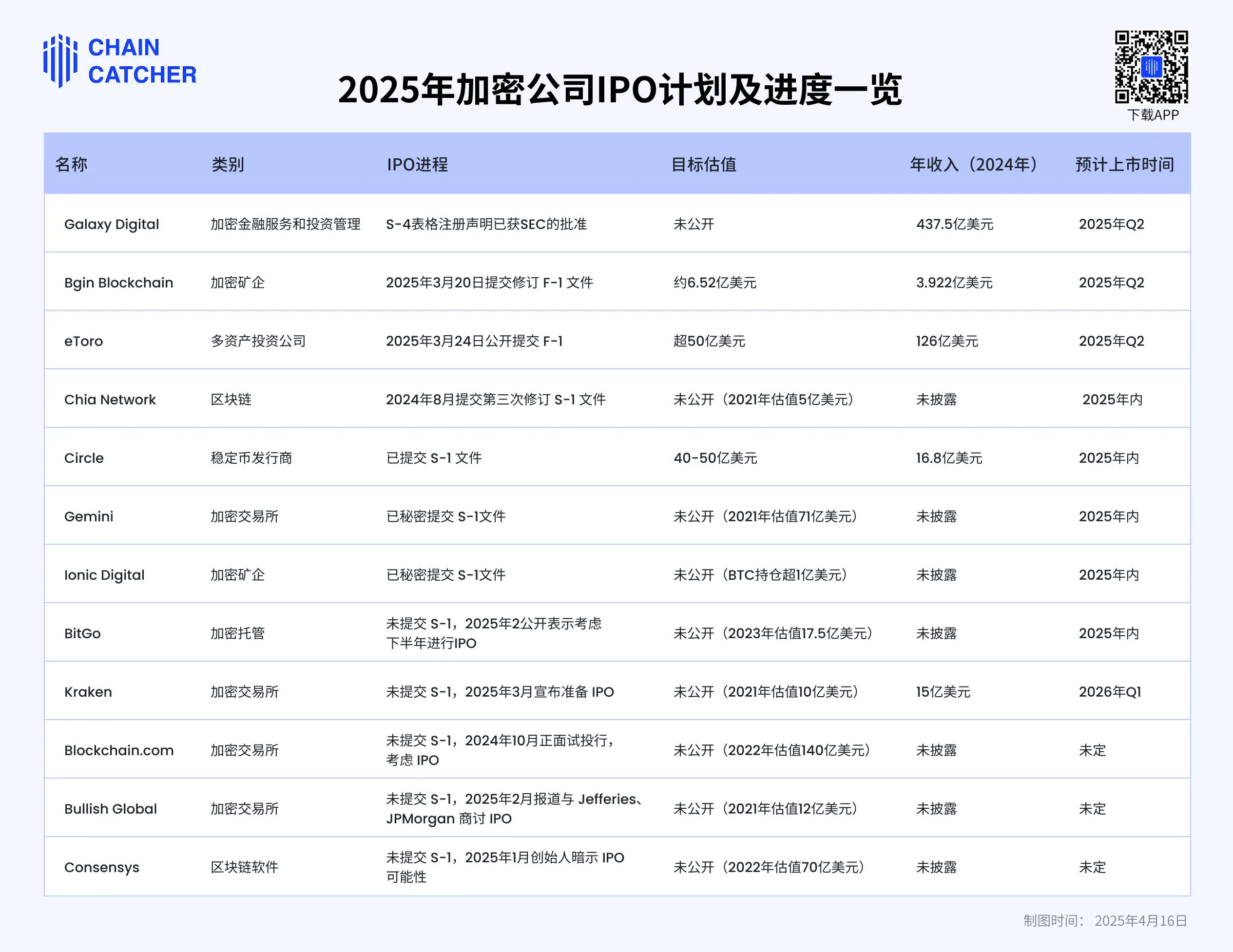
Several crypto companies that had previously planned IPOs, such as Circle, eToro, Kraken, have also seized the window of opportunity to advance their IPO plans. Currently, Circle, eToro, Bgin Blockchain, Chia Network, Gemini, Ionic Digital have submitted S-1/F-1 documents, with a higher possibility of going public in Q2 2025; BitGo, Kraken, Bullish Global, Consensys, Figure, Chainalysis, Blockchain.com have announced IPO plans or are in the stage of advisory negotiations, with significant potential for going public in 2025-2026.
The specific progress is shown in the following figure:
Related Reading: Amber listed on Nasdaq, over 10 companies went public, the era of crypto "IPO" has begun
M&A Intensifies, the Crypto Market Enters a Phase of Integration and Institutionalization
Recently, M&A activity in the crypto market has intensified. In the face of a general decline in the primary investment market, more projects are seeking exits through M&A, and top projects are more willing to optimize industrial layouts and expand influence through M&A at reasonable valuation ranges.
According to RootData data, there have been more than 40 M&A deals in the past three months, most of which were acquired by U.S. crypto companies. Since November 2024, there have been more than 10 M&A deals for five consecutive months. Large-scale M&A transactions are frequent, and M&A amounts continue to break the historical highs of the crypto market.
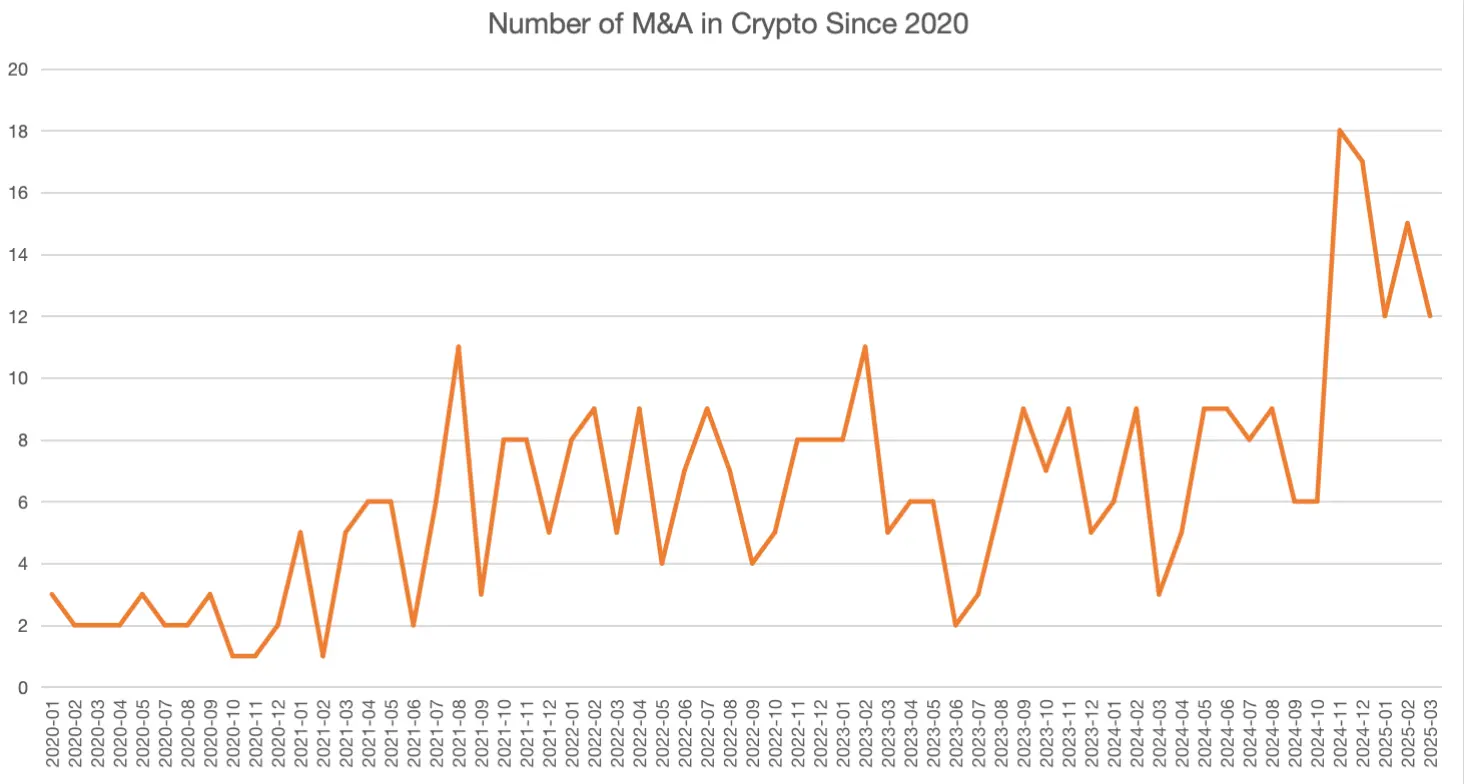
Crypto M&A trends since 2020, data source: RootData
Among these, M&A transactions exceeding $1 billion in the past six months have all occurred in the United States:
- In December 2024, traditional payment giant Stripe acquired stablecoin platform Bridge for $1.1 billion.
- In March 2025, Kraken acquired U.S. futures trading platform NinjaTrader for $1.5 billion.
- In April 2025, Ripple acquired crypto-friendly broker Hidden Road for $1.25 billion.
In addition, Coinbase is currently engaged in in-depth negotiations for the acquisition of Deribit, which is valued between $4 billion and $5 billion. Arthur Hayes' crypto derivatives platform BitMEX is seeking to sell. If Deribit and BitMEX complete the acquisition, the transaction amount will definitely break new records.
Bernstein analysts stated that as exchanges and brokers/traders models begin to merge, the crypto industry is moving toward a more integrated "one-stop" multi-asset investment platform. For example, Kraken acquired NinjaTrader, while Robinhood integrated Bitstamp, and Coinbase is currently engaged in in-depth negotiations for the acquisition of Deribit. Among them, Deribit's BTC and ETH options market monthly trading volume exceeds $100 billion, accounting for about 70% of the market share, and the monthly trading volume of crypto futures is approximately $45 billion. The acquisition of Deribit by Coinbase will enable it to expand into the derivatives field, especially the options field, and compete with Binance in the international crypto derivatives market.
In addition to options and derivatives, crypto exchanges' "multi-asset" expansion is also extending to traditional assets. On April 14, Kraken launched stock and ETF trading in the U.S. market for the first time. On April 12, several commissioners of the U.S. SEC at the second digital asset roundtable meeting expressed support for establishing a digital asset regulatory sandbox, allowing crypto exchanges like Coinbase to freely experiment in new areas, including offering tokenized securities trading. In the future, crypto exchanges will offer spot crypto currencies, crypto derivatives, tokenized stocks, and stock and stock derivatives. At the same time, platforms like Robinhood will further expand their crypto currency and crypto futures businesses.
As traditional assets are tokenized, the boundaries between crypto tokens and stocks are becoming blurred. The roles of digital asset securities, tokenization, and intermediaries will become clearer, and the overlap between crypto exchanges and brokers will increase, leading to further consolidation between traditional financial institutions and crypto companies.U.S. crypto companies will be more like Fintech (financial technology), rather than Crypto.
Crypto Companies Transition to Institutional Services
The crypto-friendly policies of the Trump administration have lowered barriers for institutional entry. The U.S. Office of the Comptroller of the Currency (OCC) approved blockchain-native loan licenses (such as Figure Technologies), encouraging traditional banks to participate. Starting in 2024, institutional services such as digital asset custody, tokenization, payments settlement, derivatives trading, and compliance solutions have become the main sources of profit growth in the crypto industry.
At the same time, due to the lack of new narratives in the entire crypto market to attract new users, crypto institutions such as exchanges have seen increased customer acquisition costs in the C-end. Crypto companies that comply with U.S. regulations and adhere to compliance have started to focus on institutional business.
Coinbase has made early arrangements for institutional services to reduce its reliance on retail trading. Its revenue from trading, especially retail trading, has been declining year by year. The percentage of retail trading fees in Coinbase's revenue was 70%, 65%, and 52.7% respectively from 2022 to 2024. At the same time, the proportion of subscription and service revenue (for institutions) has been increasing year by year, reaching 17.8%, 22.6%, and 34.8% respectively from 2022 to 2024.
As of 2024, Coinbase's custodied assets amounted to $220 billion, an increase of 100% year-on-year, mainly serving institutional clients (such as hedge funds and ETF issuers). In the past year, Coinbase became the main custodian for Bitcoin spot ETFs.
If Coinbase completes the acquisition of Deribit, it can not only expand the global crypto derivatives market, but also enhance its institutional service capabilities. In 2024, Deribit's trading volume almost doubled, and the demand for complex financial instruments from institutional investors (such as hedge funds and asset management companies) surged. Deribit's institutional client base and professional trading tools (such as options and futures) will enhance the appeal of Coinbase Prime. Recently, Coinbase Prime provided a $200 million credit support to CleanSpark, a mining company listed on Nasdaq. CleanSpark's digital asset management team has launched an institutional-level Bitcoin fund management platform.
Kraken, Gemini, and other crypto exchanges have made the same choice. Kraken's heavy investment in acquiring the U.S. retail futures platform NinjaTrader aims to expand its competitiveness in the derivatives market and extend its institutional service capabilities. In April, Kraken also announced a collaboration with Beeks Exchange Cloud to launch a custody service, planning to launch it later this year; while Gemini has expanded its institutional service business to regions such as Europe and Canada by providing USD payment support.
Ripple recently spent $1.25 billion to acquire the crypto-friendly broker Hidden Road, whose core purpose is to expand its services to institutional investors. Hidden Road is a one-stop service provider that helps large institutional investors (such as Jump Trading, market makers, and hedge funds) connect to exchanges, move money, borrow money, and settle accounts.
Ripple's main business is cross-border payments, but its ecosystem relies entirely on its own network and alliances to maintain, and the bottlenecks in its payment business are evident. In addition, last June, Ripple acquired New York-based crypto trust company Standard Custody & Trust Company. This acquisition allows Ripple to conduct crypto custody and settlement services.
Layout of Tokenization
Behind the shift of crypto companies to institutional services is the rapid expansion of the tokenization market.
Recently, Ripple jointly released a report titled "Tokenization is Approaching the Tipping Point" with Boston Consulting Group (BCG). This report made an important prediction - the tokenization market will grow from $600 billion in 2025 to $18.9 trillion by 2033, with a compound annual growth rate (CAGR) of 53%.
Tokenization refers to the process of recording ownership and transferring assets (such as securities, commodities, and real estate) using blockchain. The main application scenarios of the tokenization market include trade finance, collateral and liquidity management, investment-grade bonds, private credit, and carbon markets.
Notably, unlike the previous division of stablecoins and RWA tracks in the Chinese market, this report includes stablecoins within the scope of asset tokenization. This is basically the battleground that U.S. crypto companies are vying for - tokenization (Tokenization). The co-CEO of Kraken recently also stated that the scale of tokenized stocks is expected to exceed that of stablecoins.
Three crypto companies selected for Forbes 2025 Top 50 FinTechs, Figure, Fireblocks, and Securitize, are all engaged in tokenization, including real estate, bonds, and equity tokenization.
Figure Technologies provides home equity line of credit (HELOC), payment solutions, and asset tokenization services using its proprietary Provenance blockchain. In addition, Figure has launched its own tokenized assets. On February 20, the SEC initially approved Figure Markets (a subsidiary of Figure Technologies) to develop a yield-bearing stablecoin called YLDS. YLDS is pegged 1:1 to the U.S. dollar and is registered with the SEC as a public security, offering returns with an annualized yield of approximately 3.85% currently. YLDS is in the same financial category as stocks or bonds.
Fireblocks' core business revolves around the secure storage, transfer, and issuance of digital assets, serving financial institutions, exchanges, payment platforms, and Web3 companies. In September of last year, Fireblocks acquired BlockFold, a tokenization company, for $13.6 million to enhance its ability to provide on-chain asset services to large banks and financial institutions. Since 2024, Fireblocks has accelerated its global market expansion, and has already started operations in European countries such as Germany and France, as well as in Asia-Pacific regions such as Singapore, Japan, and South Korea.
Securitize gained public attention by collaborating with BlackRock to launch the tokenized asset BUIDL. Securitize offers integrated services, including fund management, token issuance, brokerage services, transfer agents, and alternative trading systems. On April 15, Securitize announced the acquisition of MG Stover's fund management business, making its subsidiary Securitize Fund Services (SFS) the largest digital asset fund management platform globally. This acquisition "solidified Securitize's position as an integrated platform for institutional-level tokenization and fund management."
In addition to planning an IPO, Circle is also targeting a larger tokenization market.
Circle's IPO S-1 filing shows that 95% of its revenue comes from short-term Treasury bill earnings, while its own business such as transaction fees, cross-chain bridges, and wallets generates minimal revenue. In addition to the risks associated with interest rate dependence, high compliance and distribution costs eat up most of its revenue.
Circle recently acquired Hashnote and its USYC tokenized money market fund. Hashnote is a regulated institutional-level investment management platform, incubated by Cumberland Labs (DRW's blockchain incubator), primarily providing tokenized money market funds (USYC), customized investment strategies, on-chain asset management, and custody services for institutional investors.
Disclaimer: Contains third-party opinions, does not constitute financial advice


AI Practical Guide
This column focuses on the real progress of Agents: technological evolution, application implementat

Crypto Weekly
Tracking on-chain movements of the smart money and institutions

Frontier Insights
Spotlight on Frontier, trending projects, and breaking events

Blowup Alert
As the 2026 crypto bear market deepens, exit scams and project blowups are becoming increasingly fre

Regulatory Watch
American Crypto Act – timely interpretations of policies worldwide

Popular Airdrop Tutorial
Selected potential airdrop opportunities to gain big with small investments

FusnChain
FusnChain