After Singapore "Expels" - Can Hong Kong Take Over?
After Singapore "Expels" - Can Hong Kong Take Over?


Recently, a hidden current around the ownership of the "Asian Crypto Hub" has resurfaced again.
On May 30, the Monetary Authority of Singapore (MAS) suddenly introduced new Web3 regulations with a "zero-tolerance" approach (important points in the new regulations were previously summarized by Odaily Star Daily in the article "All unregistered crypto companies must exit Singapore by the end of the month! No transition period!"). This shook the entire Southeast Asian crypto ecosystem.
On June 4, Hong Kong Legislative Council member Wu Jiezhuang made a statement on X platform: "We welcome Web3 companies operating in Singapore to relocate to Hong Kong, and we are willing to provide policy and implementation support." This statement is both an open invitation to the industry and a "relay" in the reshaping of the Web3 map.
Web3 is not a game exclusive to a single region, but a new battlefield for global financial and technological competition. Singapore is redefining its boundaries and clarifying its jurisdiction under strict regulation, while Hong Kong is accelerating exploration in cautious openness. So, beneath the storm, where will be the safe harbor for capital and innovation?
"Strong Measures" Against Web3: Singapore's Regulatory Tightening Causes Industry Turbulence
On May 30, the Monetary Authority of Singapore (MAS) issued the DTSP regulations (original text), requiring all institutions and individuals engaged in crypto token-related business to obtain a DTSP license by June 30, otherwise they must cease operations. This regulation covers exchanges, wallet service providers, DeFi protocols, NFT markets, and even KOLs who publish crypto research content. The three regulatory characteristics of MAS have been summarized by the industry as: no buffer period (immediate implementation without a transitional phase); full coverage (any entity providing digital asset services, regardless of registration location or operational model, is included in regulation); zero tolerance (violations will face fines or criminal liability).
Especially controversial was the expansion of the definition of "business premises"—even working from home in Singapore and serving overseas users is considered a regulatory target, leaving many entrepreneurs feeling "nowhere to hide."
However, on June 6, MAS issued a supplementary clarification, adjusting the scope of the policy to try to alleviate some market misunderstandings and panic (but it did not actually relax the regulatory requirements).
- The regulation focuses on institutions that provide digital payment tokens or capital market tokens to only overseas customers. Such DTSPs must obtain licenses, but MAS clearly stated that "very few licenses will be issued," and most such institutions will face exit;
- Projects providing governance or utility token services (such as DAO platforms, GameFi token items, etc.) are not included in this regulatory framework and do not need to obtain licenses;
- Institutions that have served customers within Singapore continue to operate under the existing regulatory framework, unaffected by the new regulations, and can continue to conduct domestic and international business;
- No transition period has been set, and MAS emphasized that since 2022, it has repeatedly publicly warned about this policy direction, and only a "very small portion" of institutions have been officially identified as affected.
This clarification indicates that MAS aims to precisely target "overseas service providers" with potential cross-border money laundering risks, rather than comprehensively banning the Web3 industry. At the same time, it also sends a clear signal—that after a series of credibility shocks such as Three Arrows Capital, Hodlnaut, and FTX events, Singapore's financial regulatory style is shifting from "open experimentation" to "risk prevention first." This trend may end the previous perception of Singapore as a "crypto paradise" in Asia, and put many startups in a dilemma of either high compliance costs or migration. It also indicates that Singapore's Web3 ecosystem is entering a period of regulatory restructuring: resources, structure, cost, and risk models will all be redefined.
Embracing Web3: Hong Kong's Open Regulation and Policy Advantages Emerge
In contrast to Singapore's tightening regulations, Hong Kong is accelerating its embrace of Web3 through a more flexible compliance system.
Since the release of the "Policy Statement on the Development of Virtual Assets" in 2022, Hong Kong has gradually implemented core systems including the VATP virtual asset trading platform license, stablecoin regulatory regulations, and OTC over-the-counter transaction compliance, providing market clarity.
According to data from the Hong Kong Securities and Futures Commission, so far, 10 virtual asset trading platforms including OSL Digital Securities Limited, EXIO Limited, and Hash Blockchain Limited have obtained licenses, and it is explicitly allowed for retail investors to participate in trading.
Additionally, in multiple sub-sectors such as RWA (Real World Asset) tokenization, virtual asset staking, and derivative product pilots, Hong Kong is no longer just talking about theoretical concepts:
In April this year, the world's first tokenized money market ETF (a Hong Kong dollar and U.S. dollar money market ETF tokenization plan by Boshi International and HashKey Group) was approved by the Securities and Futures Commission and launched in Hong Kong, which is also the largest virtual asset ETF market in the Asia-Pacific region;
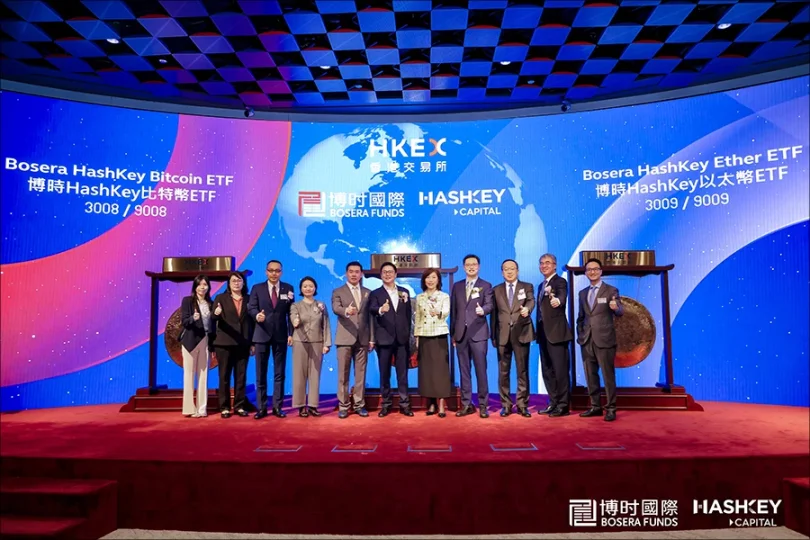
Boshi HashKey ETFs Launch Ceremony Held at HKEx
On May 30, the Hong Kong Special Administrative Region government published the "Stablecoin Ordinance" in the Gazette, meaning the ordinance officially became law, setting a regulatory framework for stablecoin issuance and use.
In terms of capital attraction and entrepreneurial support, Hong Kong is also increasing resource investment: for example, in enterprise introduction, since the release of the virtual asset declaration in 2022, the industry has been welcomed to develop in Hong Kong. According to informal statistics, thousands of Web3 companies have established themselves in Hong Kong, especially the Hong Kong Cyberport has gathered nearly 300 Web3 enterprises, with cumulative financing exceeding 400 million HKD; secondly, tax incentives are provided for virtual asset transactions that meet certain conditions (but not yet detailed); in talent introduction, a maximum monthly talent landing subsidy of 32,000 HKD is provided, as well as research funding; in policy, the government actively "attracts talents and investments," and enthusiastically attracts companies restricted in Singapore to relocate their headquarters, etc.
Compared to Singapore's increasingly strict environment, Hong Kong appears particularly "friendly" at this time, more suitable for entrepreneurs to explore and experiment with innovative initiatives.
Dream and Reality: Is Hong Kong the "New Center" or a "Transit Station"?
However, when we attempt to conclude that "Hong Kong is more welcoming to crypto entrepreneurs than Singapore," we still need to remain calm about reality.
From a factual perspective, Hong Kong indeed shows a posture of "willingness to take on more roles," but the industry is also aware that it still faces many issues and challenges: for example, although policy statements are clear, the progress of implementation is still uneven; in addition, infrastructure and supporting services are still incomplete, and early-stage startups face considerable resistance; and although the tax policy has advantages, the regulatory details are still pending further clarification.
From the entrepreneur's perspective, "migrating to Hong Kong" is not a decision made on a whim, but rather a "second-best choice" when there is no better option. Some voices even suggest that instead of establishing a new base in Hong Kong, it might be better to directly move to more favorable and low-cost crypto-friendly regions like Dubai. The crypto measures taken by the new South Korean president are also worth watching.
In other words, today's Hong Kong is more like a "transit station" after Singapore's retreat, rather than an immediate complete ecological hub.
Conclusion: The Hong Kong-Singapore Rivalry is Just a Microcosm of the Asian Web3 Ecosystem
Regulatory swings, policy differences, and ecological evolution are external manifestations of the struggle between capital and innovation forces in the Web3 era.
This time, Singapore chose to "establish regulations," while Hong Kong chose to "attract talent and investment." In the long term, this is not a black-and-white confrontation, but a reshaping of ecological positioning: Singapore may evolve into a compliant asset management center, while Hong Kong will take on the role of a technology testing ground and an Asian capital hub.
For entrepreneurs, the most important thing has never been to bet on which city, but to maintain a precise awareness and rapid response ability to policy directions, regulatory scales, and market space. The Web3 world is always fluid, and the true "safe harbor" may not only be on the map, but also in the minds of every clear-minded team.
Author: Ethan, Odaily Star Daily
Disclaimer: Contains third-party opinions, does not constitute financial advice
NVIDIA attracts $85 billion in investor demand during massive bond issuance
06-16
Ethereum surges over 10% in 24 hours, currently priced at $1,841.31
06-16Amazon announces a multi-billion dollar investment in Missouri to build a data center campus, expected to create over 400 long-term positions
06-16Binance Platform's SpaceX Perpetual Contract Trading Volume Surpasses $9 Billion, Capturing Over 60% Market Share
06-16Binance platform XLM/USDT short-term spike down to $0.17, now recovered to $0.225
06-16
Trump: The Strait of Hormuz has been fully reopened as of Friday, and all agreements have been signed
06-16SlowMist: Aztec Connect Contract Hacked for $2.19 Million Due to ZK-Rollup L1/L2 State Boundary Vulnerability
06-15
