
ChainThink
Stay ahead, master crypto insights
Four Major Changes in the Global Cryptocurrency Market After the South Korean Presidential Election
Four Major Changes in the Global Cryptocurrency Market After the South Korean Presidential Election

2025-06-02 18:12
This report analyzes how the South Korean presidential election on June 3 will trigger four major changes in the global cryptocurrency market.
Key Points Summary
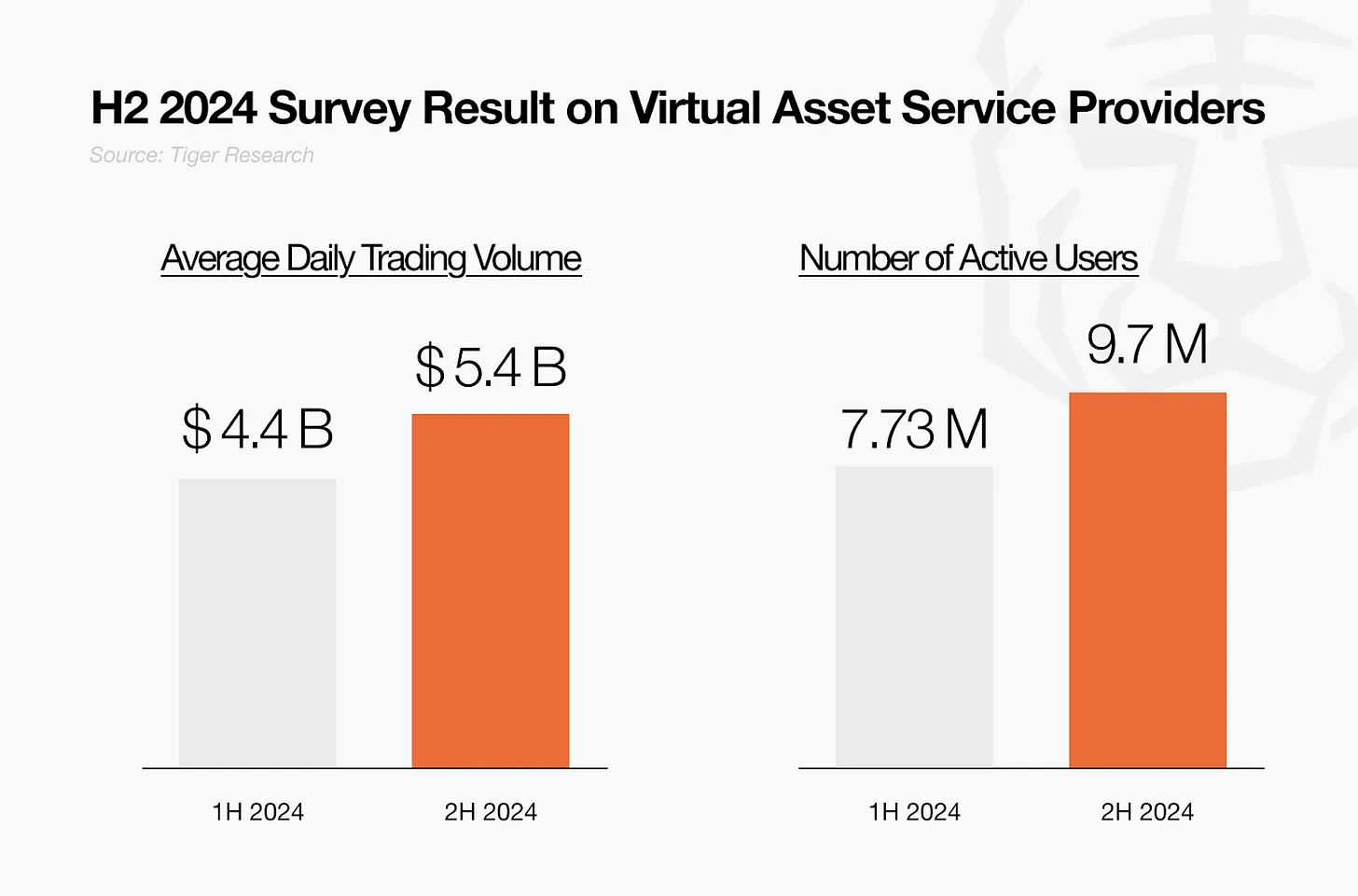
South Korea as a Core Web3 Hub: With a daily trading volume of $5.4 billion and 9.7 million active users, South Korea is the third-largest cryptocurrency market globally, following the United States and China. It serves as a critical benchmark for global projects entering the Asian market.
Taxation Acceleration or Trading Volume Decline: Although the implementation of cryptocurrency taxes has been postponed until 2027, the new government is likely to advance it. Drawing on international precedents, trading volume may drop by over 20%.
High Probability of ETF Approval; Other Reforms May Be Delayed: All major candidates support introducing Bitcoin spot ETFs, increasing the likelihood of early approval. In contrast, regulatory reforms around won stablecoins and the "one exchange one bank" policy are expected to be longer-term agenda items.
1. Is the June South Korean Presidential Election Just Local?
South Korea is scheduled to hold a presidential election on June 3. While this appears to be a local political event, its impact extends beyond national borders due to the country's influence on the global cryptocurrency market.
Source: Tiger Research
South Korea is widely recognized as the third-largest key market for global Web3 projects after the United States and China. This status is not merely the result of marketing strategies. According to the Financial Services Commission's 2024 report, South Korea's daily cryptocurrency trading volume reached 7.3 trillion KRW, with over 20 million registered accounts and 9.7 million active users.
Investor behavior further solidifies this position. South Korean users have always shown strong interest in altcoins other than Bitcoin and Ethereum. On-chain activities are also very active, making South Korea a valuable indicator for measuring the acceptance of new projects in the global market.
For many global projects, establishing a business in South Korea has become a strategic entry point into the broader Asian market.This makes the upcoming election particularly significant, as key campaign issues now include cryptocurrency taxation, regulation of won stablecoins, and the approval of cryptocurrency ETFs.
These developments are not limited to domestic stakeholders. Global investors and project operators must also pay attention to the election results. Both the possibility of regulatory tightening and relaxation exist, and projects with a large user base in South Korea may be particularly sensitive to the policy direction set by the next government.
2. What Changes Will Happen After the South Korean Presidential Election?
Source: Tiger Research
2.1. End of the Cryptocurrency Tax Deferral Policy
According to the roadmap of the Financial Services Commission regarding corporate participation in the crypto asset market, corporate entities are gradually being granted access to the cryptocurrency market. This gradual opening of the market inevitably requires corresponding comprehensive reform of the tax framework.
Currently, virtual asset taxation in South Korea is deferred until 2027. Originally, from January 2025, income exceeding approximately $1,850 would be taxed at 20%. However, this implementation was postponed by two years.
A growing controversy is that both individuals and companies currently benefit from the tax deferral policy, even though they generate income from cryptocurrency trading. According to the Financial Services Commission's roadmap, from the second half of 2025, listed companies and registered professional investment companies will be allowed to invest in virtual assets through corporate accounts.
Given this shift, the deferral policy for individuals and companies is unlikely to be extended again. The government may seek legislative revisions to abolish the current deferral policy and implement taxation earlier.
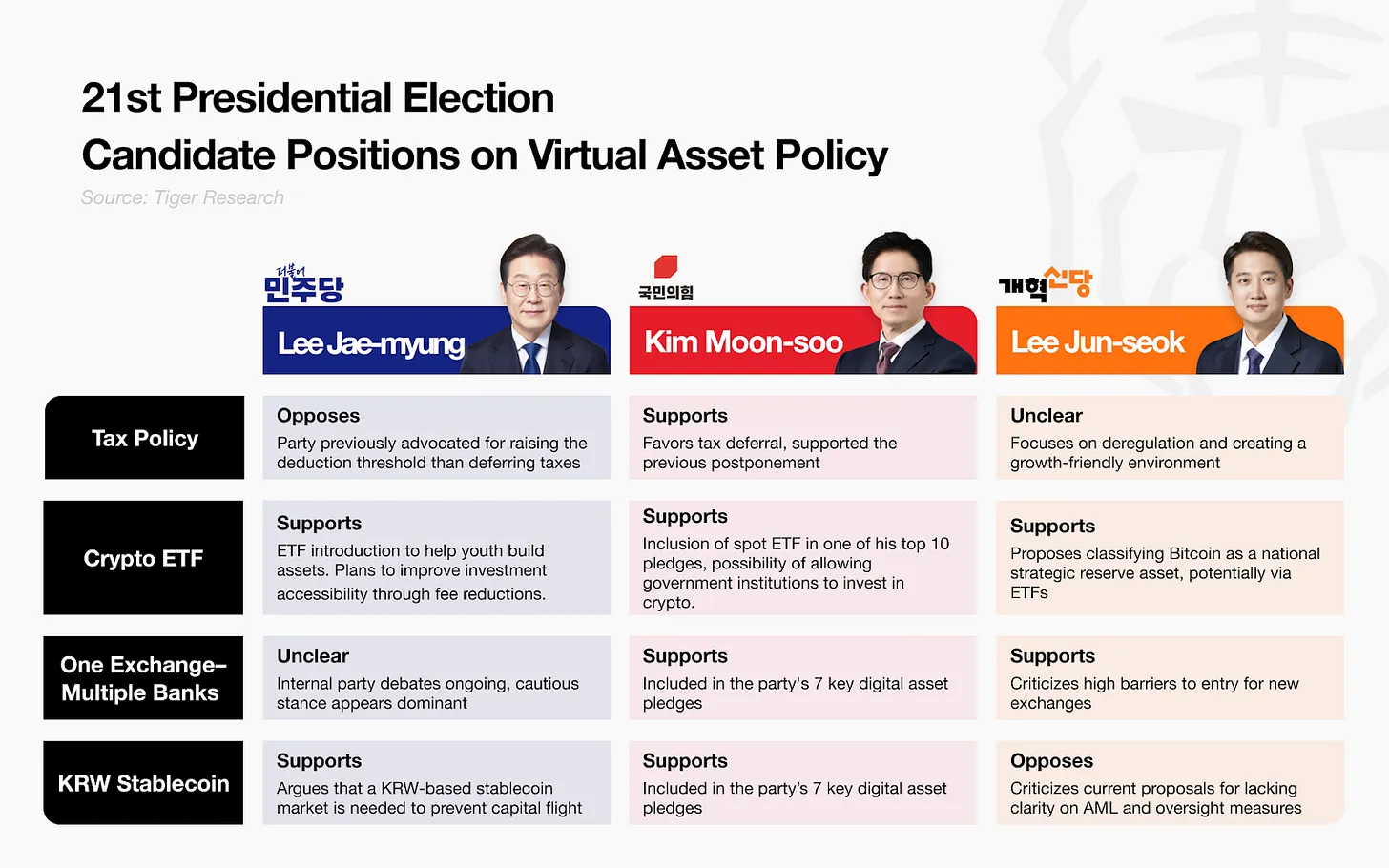
There have been political differences among parties on the issue of tax deferral. The Democratic Party initially advocated raising the tax-free threshold rather than deferring taxation, although it ultimately supported the deferral policy. Depending on the election results, the policy may shift toward increasing the deduction limit rather than maintaining the deferral policy.
If taxation is implemented, the trading volume on domestic exchanges is likely to see a significant decline—consistent with international precedents. In 2022, India imposed a 30% tax on cryptocurrency gains and introduced a 1% withholding tax on all transactions. This led to a decline of 10% to 70% in trading volumes on major platforms such as WazirX and CoinDCX. Similarly, after introducing high tax rates in 2023, Indonesia's trading volume dropped by about 60% year-over-year.
Although the proposed tax rate in South Korea is less drastic, these examples indicate that the trading volume on domestic exchanges may decline by more than 20%, while funds may shift to offshore platforms.
2.2. Introduction of Cryptocurrency ETFs
Source: Tiger Research
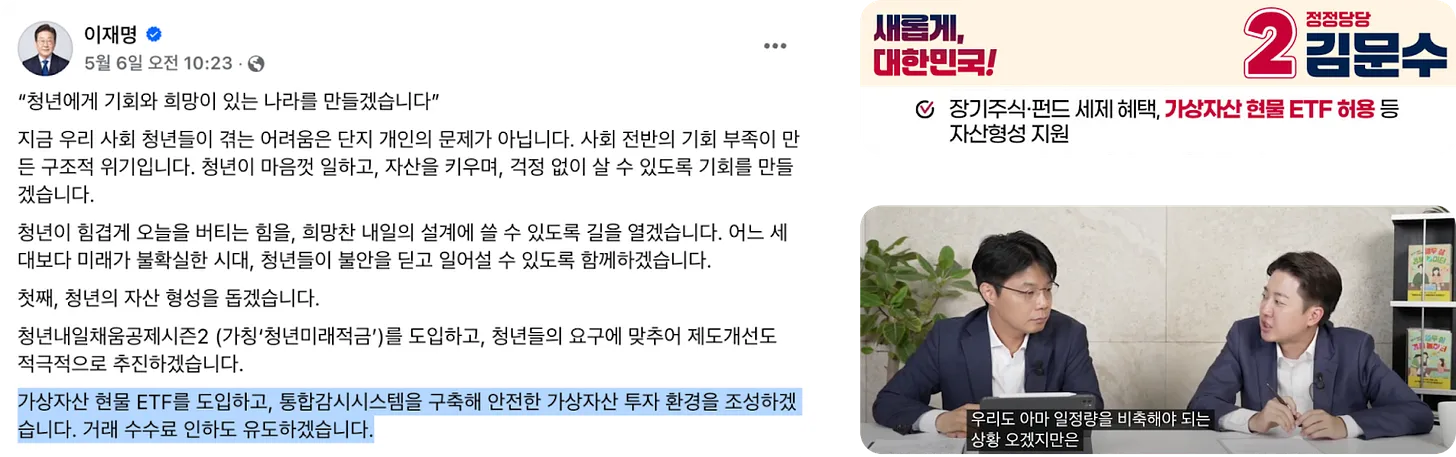
Lee Jae-myung (Democratic Party): On May 6, Lee Jae-myung announced his support for spot cryptocurrency ETFs on Facebook as part of a broader initiative to support youth asset formation. He also proposed reducing investment fees to increase accessibility.
Kim Woo-sung (People Power Party): On April 27, he expressed openness to allowing public institutions to invest in the cryptocurrency market. His ten core policy commitments included introducing spot cryptocurrency ETFs under the banner of "expanding middle-class wealth."
Lee Joon-seok (Reform Party): On May 20, Lee Joon-seok proposed on his YouTube channel that the government should hold Bitcoin as a national strategic reserve through tools like ETFs.
The introduction of spot cryptocurrency ETFs is the only policy proposal that has achieved cross-party consensus among leading candidates, making it one of the most likely outcomes in the short term. Policy discussions are expected to begin seriously shortly after the election.
If spot ETFs are introduced, they will naturally compete with existing exchanges that promote Bitcoin spot trading. This will promote healthier market dynamics and improve overall service quality. For investors, especially those with smaller portfolio sizes, lower fees can reduce barriers to entry and increase accessibility.
In the long run, the launch of spot ETFs could become a catalyst for further financial innovation. It may pave the way for new products integrating cryptocurrencies with traditional finance, such as derivatives, index funds, and other hybrid investment tools.
2.3. Re-evaluating the "One Exchange One Bank" Model
To manage anti-money laundering (AML) risks in the cryptocurrency sector, South Korea has maintained an implicit "one exchange one bank" principle. Under this model, each licensed cryptocurrency exchange is allowed to partner with only one commercial bank to issue verified deposit accounts. For example, Upbit partners exclusively with K-Bank, while Bithumb is linked to KB National Bank.
This framework contrasts with jurisdictions like the United States, where platforms like Coinbase offer integration with multiple financial services, including Apple Pay, Google Pay, and various banks.
During a policy discussion session by members of the People Power Party, the president of Woori Bank, Jeong Jin-wan, raised the issue, sparking renewed debate about abolishing the "one exchange one bank" rule. He argued that the current structure poses systemic risks, limits consumer choice, and imposes unnecessary restrictions on enterprise clients. Jeong called for transitioning to a "one exchange multiple banks" model.
As the presidential campaign progresses, political parties have begun to take stances. On April 28, the People Power Party included abolishing the "one exchange one bank" rule in its "Seven Digital Asset Commitments." The Democratic Party appears to be reviewing the matter internally. However, there has been a cautious stance within the Democratic Party, and it remains unclear whether this issue will be reflected in official campaign promises. The financial regulatory authorities have also taken a cautious position, indicating that any changes may require long-term deliberation.
While regulatory caution is necessary, maintaining the current model based on concerns about market concentration and AML risks may need re-evaluation. The argument that this rule prevents market monopolies is becoming increasingly less persuasive, as Upbit and Bithumb already control about 97% of the domestic market.Allowing multiple banks to collaborate can strengthen competition by enabling exchanges to serve a broader user base, potentially offering lower fees and more innovative services to retail and institutional users.
Concerns about AML risks also require a more nuanced assessment. In fact, the greater risk lies in the transfer of funds to overseas exchanges. Since the implementation of the Travel Rule and improvements in compliance infrastructure, South Korea now operates under stricter international monitoring standards. In this context, the systemic risks associated with multiple banking relationships seem exaggerated.
2.4. Won Stablecoins
Historically, South Korea has prioritized central bank digital currencies (CBDCs) over stablecoins. The Bank of Korea is currently conducting a pilot program called "Project Han-Gang" to test a payment and settlement system based on CBDCs. However, as global trends shift toward stablecoins, domestic demand for won stablecoins is growing.

Source: 21st Presidential Debate: First Presidential Debate
Lee Jae-myung (Democratic Party):
May 8: In an economic YouTube interview, he stated that won-based stablecoins could prevent capital flight by creating domestic alternatives.
May 18: In a television debate, he emphasized that won stablecoins would be backed by collateral reserves to ensure stability.
Lee Joon-seok (Reform Party):
May 18: Questioned the feasibility of Lee Jae-myung's proposal, citing a lack of clarity in anti-money laundering measures in stablecoin issuance.
Kim Woo-sung (People Power Party):
April 28: Included a regulatory framework for stablecoins in his "Seven Digital Asset Commitments."
The first presidential debate on May 18 brought stablecoins into mainstream political discourse through the exchange between Lee Jae-myung and Lee Joon-seok. While the discussion showed directional support, it also highlighted the lack of detailed policy frameworks—especially regarding risk mitigation and compliance.
At this stage, proposals for won stablecoins remain visionary rather than operational. The likelihood of immediate implementation after the election is low. However, considering regional trends—particularly in Singapore and Hong Kong, where authorities are actively developing stablecoins pegged to local currencies—South Korea may face increasing pressure to catch up to maintain its competitiveness as a financial hub.
Any meaningful progress will require a foundational legal and regulatory framework. Key issues include determining qualified issuers, ensuring collateral transparency, establishing anti-money laundering protocols, and defining the relationship between stablecoins and CBDC initiatives. Given the complexity of these issues, policy development is expected to proceed in a phased, medium-to-long-term manner rather than undergoing rapid changes after the election.
3. Gradual but Inevitable: Upcoming Changes
Although the discussed policy shifts are significant for the industry, they are unlikely to happen in the short term. Among the main presidential candidates, only Kim Moon-soo included Web3-related measures in his top ten campaign pledges. This indicates that, despite their relevance to the industry, Web3 issues are not a priority in the current broader policy agenda.
Therefore, regulatory changes are expected to proceed gradually, with discussions likely to parallel more urgent policy matters. However, the trajectory is clear: transformation is inevitable.
As mentioned earlier, the final implementation of cryptocurrency taxation is inevitable. Additionally, discussions on the legislation surrounding security token offerings (STOs) are expected to resume. Investors and market participants should not underestimate these transformations. Stakeholders must start preparing for a policy environment that will become increasingly regulated and compliant.
Author: Ryan Yoon, Tiger Research
Disclaimer: Contains third-party opinions, does not constitute financial advice


AI Practical Guide
This column focuses on the real progress of Agents: technological evolution, application implementat

Crypto Weekly
Tracking on-chain movements of the smart money and institutions

Frontier Insights
Spotlight on Frontier, trending projects, and breaking events

Blowup Alert
As the 2026 crypto bear market deepens, exit scams and project blowups are becoming increasingly fre

Regulatory Watch
American Crypto Act – timely interpretations of policies worldwide

Popular Airdrop Tutorial
Selected potential airdrop opportunities to gain big with small investments

FusnChain
FusnChain